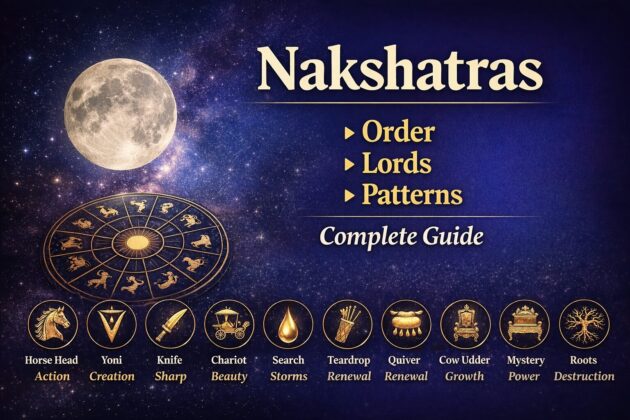
If you go beyond surface-level astrology, Nakshatras are where things start making real sense.
Rashis show your broad personality.
Nakshatras show how that personality actually functions — your instincts, reactions, and karmic patterns.
This guide keeps things simple but meaningful:
- The correct sequence of all 27 Nakshatras
- Their ruling planets
- The deeper grouping pattern that most people miss
The 27 Nakshatras in Order with Their Lords
- Ashwini — Ketu
- Bharani — Venus
- Krittika — Sun
- Rohini — Moon
- Mrigashira — Mars
- Ardra — Rahu
- Punarvasu — Jupiter
- Pushya — Saturn
- Ashlesha — Mercury
- Magha — Ketu
- Purva Phalguni — Venus
- Uttara Phalguni — Sun
- Hasta — Moon
- Chitra — Mars
- Swati — Rahu
- Vishakha — Jupiter
- Anuradha — Saturn
- Jyeshtha — Mercury
- Mula — Ketu
- Purva Ashadha — Venus
- Uttara Ashadha — Sun
- Shravana — Moon
- Dhanishta — Mars
- Shatabhisha — Rahu
- Purva Bhadrapada — Jupiter
- Uttara Bhadrapada — Saturn
- Revati — Mercury
At first glance, this looks like something to memorize. It is not.
There is a pattern underneath.
The Core Pattern Most People Miss
The ruling planets follow a strict and repeating cycle:
Ketu → Venus → Sun → Moon → Mars → Rahu → Jupiter → Saturn → Mercury
Then the sequence repeats.
This pattern is not random. It forms the backbone of the Vimshottari Dasha system, which is one of the most accurate timing systems in Vedic astrology.
Once you internalize this cycle, the entire Nakshatra system becomes easier to understand rather than memorize.
Nakshatras Grouped by Their Lords
Each planet rules exactly three Nakshatras. Understanding these groups gives much deeper insight than looking at Nakshatras individually.
Ketu Nakshatras
Ashwini, Magha, Mula
These Nakshatras deal with beginnings and endings at the same time. They carry a sense of detachment, past-life influence, and sudden shifts. There is often a push toward spiritual growth or breaking old patterns.
Venus Nakshatras
Bharani, Purva Phalguni, Purva Ashadha
These are about experience — pleasure, creation, relationships, and expression. There is a strong connection to desire, attraction, and enjoying life, but also learning through it.
Sun Nakshatras
Krittika, Uttara Phalguni, Uttara Ashadha
These Nakshatras carry themes of responsibility, authority, and leadership. They are connected to identity, self-respect, and the ability to stand on one’s own.
Moon Nakshatras
Rohini, Hasta, Shravana
These are deeply connected to the mind and emotional patterns. They nurture, absorb, and respond. These Nakshatras often indicate how a person learns, adapts, and connects.
Mars Nakshatras
Mrigashira, Chitra, Dhanishta
These bring movement, ambition, and action. There is a constant search, a drive to build, and a need to express energy outwardly.
Rahu Nakshatras
Ardra, Swati, Shatabhisha
These are unconventional and intense. They break norms, create disruption, and push growth through unusual paths. They often bring sudden changes and strong desires.
Jupiter Nakshatras
Punarvasu, Vishakha, Purva Bhadrapada
These focus on expansion, wisdom, and purpose. There is a sense of direction, belief, and a search for meaning beyond the material.
Saturn Nakshatras
Pushya, Anuradha, Uttara Bhadrapada
These are about discipline, structure, and long-term growth. They reward patience and consistency, often bringing delayed but stable results.
Mercury Nakshatras
Ashlesha, Jyeshtha, Revati
These deal with intelligence, communication, and adaptability. There is sharpness of mind, strategic thinking, and the ability to navigate complexity.
Why This Structure Matters
Most people try to study Nakshatras one by one. That approach makes it feel overwhelming.
A better way is to understand:
- The sequence
- The repeating planetary cycle
- The grouping under each planet
Once you see this structure, patterns start to emerge in charts very quickly.
You begin to understand not just what a Nakshatra is, but how it behaves in relation to others.
Here is a quick overview of the 27 Nakshatras and their primary symbols:
| No. | Nakshatra | Symbol |
| 1 | Ashwini | Horse’s head |
| 2 | Bharani | Yoni (womb/birth canal) |
| 3 | Krittika | Knife, blade, or flame |
| 4 | Rohini | Ox cart, chariot, or temple |
| 5 | Mrigashira | Deer’s head |
| 6 | Ardra | Teardrop, diamond, or human head |
| 7 | Punarvasu | Bow and quiver |
| 8 | Pushya | Cow’s udder, lotus, or arrow |
| 9 | Ashlesha | Coiled serpent |
| 10 | Magha | Royal throne or palanquin |
| 11 | Purva Phalguni | Front legs of a bed or hammock |
| 12 | Uttara Phalguni | Four legs of a bed or hammock |
| 13 | Hasta | Hand or fist |
| 14 | Chitra | Bright jewel or pearl |
| 15 | Swati | Young plant shoot in the wind or coral |
| 16 | Vishakha | Triumphal arch or potter’s wheel |
| 17 | Anuradha | Triumphal arch or lotus |
| 18 | Jyeshtha | Circular amulet, umbrella, or earring |
| 19 | Mula | Tied roots or an elephant goad |
| 20 | Purva Ashadha | Elephant tusk or winnowing basket |
| 21 | Uttara Ashadha | Elephant tusk or plank of a bed |
| 22 | Shravana | Ear or three footsteps |
| 23 | Dhanishta | Drum or flute |
| 24 | Shatabhisha | Empty circle or 100 flowers/stars |
| 25 | Purva Bhadrapada | Swords, two front legs of a cot, or two-faced man |
| 26 | Uttara Bhadrapada | Twins or back legs of a cot |
| 27 | Revati | Pair of fish or a drum |
Final Thought
Nakshatras are not just divisions of the sky. They are patterns of experience.
If Rashis describe the stage, Nakshatras describe the script.
And when you start recognizing the script, astrology stops being theoretical and starts becoming practical.
Author Profile

-
Team at Feel Good Now 24/7
Bringing you interesting feel-good content!
Latest entries
 SpiritualityMarch 28, 2026Shri Venkatesh Stotra with English Translation
- CelebrityMarch 23, 2026Tom Cruise’s Watch Collection: The Quiet Power of Precision and Luxury
- Feel Good NowMarch 22, 2026Choosing the Right Sub-Compact SUV in India (2026)
- Feel Good NowMarch 22, 2026Top Solar Wrist Watches For Men To Buy




Any comments?