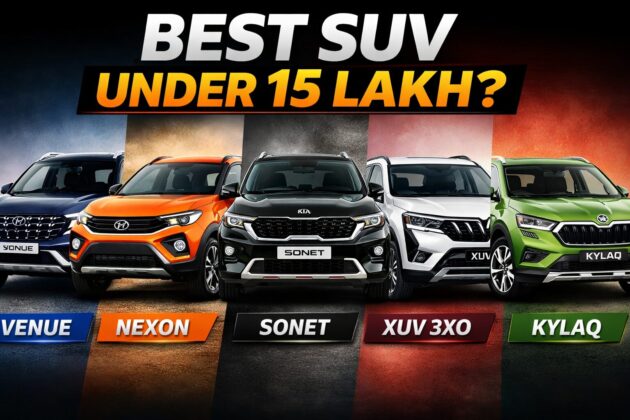
The sub-compact SUV segment in India has reached a level of maturity where most products are fundamentally competent. The challenge today is not identifying a “good car,” but identifying the car that aligns best with your priorities.
When evaluating options such as the Hyundai Venue, Tata Nexon, Kia Sonet, Mahindra XUV 3XO, and Skoda Kylaq, the differences lie less in specifications and more in execution.
This analysis focuses on real-world ownership, not brochure comparisons.
Understanding the Segment Reality
All vehicles in this category are designed primarily for urban usage with occasional highway runs. However, each manufacturer approaches the segment with a different philosophy:
- Korean brands prioritise refinement, features, and ease of use
- Indian manufacturers emphasise safety and ride quality
- European brands focus on driving dynamics and build integrity
Recognising this positioning is essential before making any decision.
Hyundai Venue: Benchmark for Refinement and Usability
The Hyundai Venue stands out for its polish.
The engine refinement is among the best in the segment. At idle, the cabin remains exceptionally quiet, and in city driving conditions, the light controls make it effortless to operate. This is particularly relevant for dense urban environments.
Hyundai’s feature packaging remains competitive, offering elements such as wireless connectivity and driver aids even in mid variants. However, recent pricing revisions have diluted value. Certain omissions—such as the absence of automatic climate control or a centre armrest in key variants—are difficult to justify at current price points.
From an ownership standpoint, Hyundai Motor India continues to offer one of the most consistent service experiences in the country.
Assessment:
The most well-rounded option for buyers prioritising refinement, ease of driving, and predictable ownership.
Tata Nexon: Strong Fundamentals, Inconsistent Execution
The Tata Nexon remains a structurally robust product.
Its ride quality is particularly well-suited to Indian road conditions, absorbing uneven surfaces better than most competitors. Seating comfort is also among the best in the segment, making it suitable for long-distance travel.
However, the powertrain is a weak link. The petrol engine lacks refinement, with noticeable noise and vibration entering the cabin. Clutch feedback issues, as observed in multiple test drives, can affect daily drivability in traffic.
While Tata Motors has improved significantly, after-sales consistency still varies across locations.
Assessment:
A logical choice for safety and ride comfort, but not for those sensitive to refinement or tactile driving quality.
Kia Sonet: Balanced but Strategically Limited
The Kia Sonet continues to be a compelling product with strong visual appeal.
Its interior quality and feature list remain competitive, though the newer Venue has edged ahead in perceived modernity. The primary limitation lies in the transmission strategy—buyers seeking a turbocharged manual are restricted, with iMT being the only alternative.
While iMT is functional and relatively smooth, it does not fully replace the engagement of a traditional manual transmission.
Kia India has made steady progress in service quality, reducing initial concerns.
Assessment:
A strong all-rounder, but compromised for buyers who prioritise manual driving engagement.
Mahindra XUV 3XO: High Capability, Limited Emotional Appeal
The Mahindra XUV 3XO is a technically sound offering.
Its turbocharged petrol engine delivers strong performance, and the feature list is extensive. Mahindra has also improved interior quality compared to its predecessor.
However, design remains subjective and plays a critical role in this segment. Additionally, real-world fuel efficiency in city conditions tends to drop due to turbo characteristics. Boot space constraints also remain a practical limitation.
Assessment:
A rational choice that may not resonate emotionally with all buyers.
Skoda Kylaq: Driver-Centric, but Not Without Trade-offs
The Skoda Kylaq reflects European priorities.
It offers one of the most engaging driving experiences in the segment, supported by a responsive turbocharged engine and stable high-speed dynamics. Interior design is understated and premium.
However, variant pricing escalates quickly, and certain elements—such as camera quality and perceived equipment value—lag behind competitors. Rear design acceptance is also subjective.
Skoda Auto India has improved service reach, but perception still trails Korean brands. I personally like this one for its elegant look from the front and smooth driving performance but yes it does lack some features like 360 degree camera.
Assessment:
Best suited for buyers who prioritise driving dynamics over feature density.
Key Ownership Insights
Across multiple user experiences and test drives, a few consistent patterns emerge:
- Engine refinement has a direct impact on daily satisfaction
- Ride quality matters more over time than initial feature appeal
- After-sales experience influences long-term ownership more than specifications
- Design preference often determines post-purchase satisfaction
These factors tend to outweigh spec-sheet comparisons within months of ownership.
Usage-Based Recommendation
For a usage pattern of approximately 800 km per month, primarily in city conditions:
- Low effort controls and smooth drivability become critical
- Noise and vibration are more noticeable over time
- Fuel efficiency differences are relatively marginal across petrol options
Under these conditions, vehicles prioritising refinement and ease of use gain a clear advantage.
Final Recommendation Framework
- Choose the Hyundai Venue for refinement, ease of driving, and ownership peace of mind
- Choose the Tata Nexon for safety and superior ride quality
- Choose the Kia Sonet for design and a balanced feature set
- Choose the Skoda Kylaq for driving engagement
- Choose the Mahindra XUV 3XO for performance and feature value
Professional Advice
A short test drive is insufficient for decision-making in this segment. If possible, spend extended time with your shortlisted vehicles under real driving conditions. This is often the most reliable way to identify deal-breakers.
Conclusion
There is no objectively superior product in this category. Each vehicle represents a different engineering and market philosophy.
The correct choice is not the car with the most features or the best specifications, but the one that aligns most closely with your daily usage and expectations.
Author Profile

-
Team at Feel Good Now 24/7
Bringing you interesting feel-good content!
Latest entries
 SpiritualityMarch 28, 2026Shri Venkatesh Stotra with English Translation
- CelebrityMarch 23, 2026Tom Cruise’s Watch Collection: The Quiet Power of Precision and Luxury
- Feel Good NowMarch 22, 2026Choosing the Right Sub-Compact SUV in India (2026)
- Feel Good NowMarch 22, 2026Top Solar Wrist Watches For Men To Buy





Any comments?